Showing posts with label dream sleep. Show all posts

Tuesday, 1 October 2013

The Effects of Sleep Deprivation - Babies and Toddlers

This is the first in a series about the effects of sleep deprivation on different groups and ages of people. Today we will be looking at young children.

Babies - though most people's perceptions of young babies is that they sleep all the time, it is in-fact possible (though rare) for babies to be sleep deprived. This can have a negative impact on their health and their growth, also with the suggestion that sleep deprivation can lead to babies being overweight. Research has also shown that babies who get enough sleep are more easy going and approachable.

In my years of working in day care I have noticed that babies who struggle with their sleep and do not get enough are more grumpy and irritable. They find separation from their parents difficult and are more easily distressed during the day. Once we had set up a good napping schedule for them, they found the day more easy going, were able to engage in activities and were happier and more content.

One of the problems in diagnosing sleep deprivation in babies is that all seem to have different sleep needs and habits. One baby may sleep happily anywhere at the drop of a hat, while another needs a more organized routine and environment to sleep. A baby who once slept through the night may suddenly start waking two or three times. As a rough guideline this chart shows the ideal times of recommended sleep through childhood. For babies and toddlers this is spread across daytime naps and nighttime sleeping.

Age                    Hours Of Sleep
0 - 2 months       10.5 - 18
2 - 12 months     14 - 15
1 - 3 years          12 - 14
3 - 5 years          11 - 13  
5 - 12 years        10 - 11

If you can recognize the signs of tiredness in your baby and act straight away by putting them to bed, then you will be setting them up for a good sleep pattern for life. These signs may include (and this list is not exclusive)-
pulling their ears, their eyelids looking red, rubbing their eyes, a glazed look in their eyes and a far away expression on their face, yawning, starting to cry for no reason and not being comforted or distracted by stimulation, lack of interest in toys or stimulation.

As babies grow their sleep needs change and things such as teething, growth spurts and starting daycare can affect their sleep patterns.

Toddlers still need plenty of sleep and like all age groups suffer from the affects of sleep deprivation. I am sure that most parents have a picture or two of a tired toddler who has fallen asleep in a strange place! However a lack of sleep can affect their learning and social skills, as well as their growth. Again sleep deprived toddlers can gain weight - but weight gain has many causes, not just sleep deprivation.

Toddlers are far more mobile than babies and conversely the signs of a tired toddler include running around and wild behaviour, this is a last stand against the tiredness that is growing in their bodies and not a sign that they have loads of energy left to burn. A toddler will naturally be energetic when they wake from a sleep but if they are running around in the late evening before bedtime it is that they are overtired, not full of energy that needs to burnt off.

Sleep deprived toddlers are also more likely to have moods and tantrums - but then this is also typical toddler behaviour!

In order to work out if your toddler is sleep deprived observe and record their behaviour, if they are having more tantrums and wild behaviour in the evenings or before nap time it points to them being tired. Also have a bedtime routine that allows for a wind-down, the last hour before bed should be calming and restful with quiet activities such as a bath and time for stories. Download a good bedtime routine here.
Though it may take a few days (or nights) of effort, establishing a good bedtime routine at this early age will help your child be bright, alert and ready to learn important life skills.

If you are having problems settling a baby or toddler into a sleep routine then please contact a professional for correct advice and sleep training.

It goes without saying that young babies and sleep deprivation of new parents goes hand in hand - and I will address meeting the sleep needs of parents in a later post. 


Tuesday, 10 September 2013

Caffeine - the acceptable addiction?


The other day I tripped when walking down the street and landed on my knees - very hard! After a weekend of constant pain and lack of sleep, I went to the doctor's (and as is typical in France) came away with a long prescription of various drugs to 'help' the pain and recovery.

To my interest one of the drugs proudly stated it was a mixture of paracetamol, opium and caffeine. (I'm presuming the caffeine is to counteract the opium.)
Normally when caffeine is present in medications, it is hidden away in small letters on the info sheet and you have to use a magnifying glass to find its listing! So to find it in large letters on the front of the bow was very unusual.

Now, I've not properly drunk caffeine for years (since I was about 18) as the doctor thought that my 6-cans-of-diet-cola a day habit might possibly be a cause of my insomnia, and there was I thinking I was being healthy because it was 'diet'.
Fortunately I did not really like coffee anyway, and the cola was surprisingly easy to give up. It was the tea that was difficult. I really love tea, still do in fact. If I'm up really early - maybe because I have a flight to catch, I may still sneak in a cup of tea but these are very rare occasions.

Nowadays I don't really think about caffeine. Sometimes the question will raise its head, such as when I moved to France, where it seems that everybody drinks coffee. Fortunately there are plenty of other options available. When I first gave it up there were only a few herbal teas available and decaff coffee, now there is a whole range of flavours and tastes to choose from Rooibus is one of my favourites, followed by fennel tea.

People ask me if I miss it, I do not really, and one lady spontaneously threw her arms round me and gave me a hug as she felt so sorry for me that I could not enjoy a morning cup of coffee.

So here's the rub - people need a morning fix of coffee because they are , heartburn addicted to it. Caffeine causes a little high immediately after consumption and then as its affect wears off it causes a slump, so reaching for another cup of caffeine restores the feeling of a high. If you were to completely come off caffeine your body would not need a morning 'fix' anymore.

Caffeine in moderate quantities has been shown to have positive health benefits such as protection from coronary disease, Parkinson's, diabetes and some cancers however an excess causes stress to the body such as osteoporosis, stress, heartburn and other stomach disorders. Caffeine's biggest downfall is that excessive consumption leads to insomnia which, in turn, leads to many other health problems such as diabetes, heart problems, weight gain etc. As well as triggering insomnia which in turn adds further stress.

The recommendation is that between 200 and 300mg a day is a safe level, over 500mgs can start causing health problems.
The problem with this statistic is that the amounts of caffeine in drinks and food varies widely, so you need to keep an eye on how much you drink. Remember that it is not just in tea and coffee but also in green teas, colas and some other soft drinks, chocolate and of course energy drinks.

So if you are having trouble sleeping, is caffeine dependency your problem? Like any drug, coming off caffeine can cause withdrawal symptoms including headaches, sleepiness, lethargy, flu-like symptoms, muscle aches and depression. Try reducing caffeine bit by bit, cutting out a cup or two of caffeine at each stage or swapping high caffeine drinks for ones lower in caffeine and, best of all, stop drinking it at least 6 hours before bedtime. If you suffer from withdrawal symptoms remind yourself that they are only temporary and will diminish.

If you would like to know how much you are drinking then check out this list.

Good luck and sweet dreams.

If you would like more help with achieving overcoming insomnia and other sleep problems then please contact me at charlotte@charlottewelply.com and we can set up a free introductory coaching session.

Tuesday, 9 July 2013

To share or not to share?

e
After last week's slightly tongue in cheek post about duvet stealing, this post is about ways to share a bed in comfort.

Historically people have always shared beds as beds, bedding and even extra bedrooms were expensive and prohibitive. It was only the super rich that could afford to have separate bedrooms. In the past if you were a single traveler you may well have shared a hotel bed with a total stranger. Siblings, if not whole families, would sleep together in the same bed.

There is also the simple fact is that as a general rule, humans do sleep better on their own. Everyone seems to have slightly different needs in terms of warmth, bed softness, space etc. Against this is the need to balance the need for intimacy in a relationship and studies have shown that sleeping separately can impact negatively on relationships.

So what to do if you do want to sleep in the same bed but have different needs?


Respect different body clocks
A night owl married to a morning lark is a nightmare combination for bedtimes, the good news is that the majority of the population are hummingbirds and can adapt to either. However some people do prefer early bedtimes while others would like to stay up an hour or so more. If this is your situation then have a discussion with your partner. Maybe they are not being lazy in the mornings but genuinely getting some restorative sleep? Perhaps it's not the lure of another TV show that is stopping them coming to bed with you but a real feeling that they are not tired. If you do opt for different bedtimes then make sure you have some shared bedtimes, perhaps at the weekend, to keep a level of intimacy within the relationship, as this allows for and respects different sleep needs.


Buy as large a bed as possible 
Though falling asleep wrapped in each other's arms seems the romantic thing, we actually need a lot of space when sleeping and a larger bed will help with this.
If you both like different levels of support from a mattress then it is possible to buy two different mattresses that zip together.
Although buying a new bed may seem like a huge investment, it is the place where you will spend a third of your life and can help reduce stress levels in a relationship. Is that not worth paying for?

Have two different duvets
Although I joked about this last week this is a very easy and practical solution if one person prefers warmer bedding and the other throws of heat (and the covers) during the night. It is also possible to buy different duvet weights that again zip together.

Technology
What to do if one person likes watching TV to fall asleep and the other prefers peace and quiet? As a general rule technology in the bedroom disturbs sleep rather than enhances it, so I do recommend taking out TV's and computers. How about listening to a podcast with earphones, or investing in a 'speaker pillow' that you can plug your mp3 player into. A little light than you can clip onto a book is less intrusive than a bedside light. Likewise eye masks and earplugs can help too. Discuss and compromise, one person should not be making all the sacrifices as this will cause resentment.

Pets
An area that needs discussion and agreement however pets have no understanding of respecting bed space and if they are disturbing your sleep, then they should not be allowed to sleep on the bed, hygiene issues aside, they simply take up to much space. If necessary then they can be trained to sleep on their own bed in your room.

These are just a few suggestions, I would love to hear from you any thing that you have found useful, please comment below.

Sweet dreams. 

Tuesday, 18 June 2013

Pamper yourself to sleep

I don't know about you but I hate rules and guidelines, I find them very restrictive even if they are trying to help me. When it comes to getting a good night's sleep there seem to be loads of them and they can seem quite strict and very forbidding! Take these for example

- stop drinking caffeine in the afternoons
- set up a bedtime routine
-switch off technology an hour before bed time


One of the tricks that I learnt about sleeping well was to change these round in my head, so that they seemed as if I was pampering myself. And I was, because a good night's sleep is an affordable luxury in this fast paced world!

Mentally rephrasing the above statements I came to these conclusions

Why not try drinking herbal teas instead of tea or coffee? When my doctor told me to come off caffeine I found it really hard and felt deprived, and still allowed myself a morning cup of tea. I explored the world of 'decaffeinated' but just felt as if I was being let down as it didn't taste quite right. After a while I came to realize that as herbal teas tasted nothing like real tea it was just a different taste and not a substitute, this helped me a lot. I then discovered that herbal teas did actually have a lot of health benefits and help my body in more ways than just caffeine elimination. Check this page for more information.  Now when people start to make sympathetic faces when I say 'I don't do caffeine', I have to stop them as I genuinely do not feel deprived but feel as if I am making healthy choices for my body.

How about having a bath before you go to bed? This is a lovely bit of pampering, I add some bath salts or oils, dim the lights/use candles, play soothing music to really help me relax and unwind. Then using lovely creams and oils to moisturise my skin and body afterwards and slipping into clean, fresh smelling pj's all adds to the luxurious, pampering feeling. It also means that I have an easily enforced no screen time before bed too! I have a bath whenever I have to get up really early the next morning and see it as a treat not part of a strict routine.

If you are a couple or family why not start having 'Family Time' together each evening? Yes, this means turning off computers, ipads etc so that you interact together in the the last couple of hours before bedtime. Play games, read books aloud, watch a film together (the TV screen is less stimulating for your eyes and brain than a computer/phone screen.) Quality time with your family or partner is always a great feel good session and this way has so many added health benefits as well.

I hope these ideas have given you food for thought on how to pamper yourself a little each day to enable yourself to relax and unwind before bedtime!

Sweet dreams. 

Tuesday, 11 June 2013

Oxygen Masks


In the safety briefing on the aeroplanes (you know that bit at the beginning of a flight that no-one really listens too) we are informed that in the case of having to use an oxygen mask that we should put one on ourselves first and then help those around us to put on theirs.
It makes sense because the drop in oxygen can happen so quickly that if you were to spend those seconds helping a child put on their mask, that you would be unconscious before you would be able to put on your own.
I find that our instinct as women is to put others first, especially if we have children and families. We are able to put so much pressure on ourselves, running a business and a household that we burn ourselves out.
In order to make more time in the day for others we sacrifice the very thing that would help us perform better in the first place. Sleep.

In this modern fast-paced world sleep is the essential that we think we can do without. Sleep seems to take up so much time. It seems easier to go to bed just half an hour later so that we can finish a work assignment, make a cake for the cake sale, check the emails one last time, stay longer at an after hours work function, catch a TV programme etc. It doesn't appear to have any major affect, so we repeat it another night, telling ourselves that we will catch up at the weekend.

Then the weekend is busy too, and so is the following week and before we fully realise, bedtime is creeping slowly but surely to a later and later time and we are failing to get a regular 7-9 hours sleep we need each night and are regularly surviving on 6 hours or less. Although you may feel tired or sleepy and believe there to be no immediate short term affects, the research shows otherwise.

There will be immediate affects on your performance and alertness, so staying up late to finish your work will impact on your ability to be efficient at work the following day. Sleep deprivation also can affect your alertness when driving or operating machinery, your effectiveness at making decisions, as well as causing stress in relationships - both personal and professional.

Long term sleep deprivation starts affecting your health including blood pressure, weight control, mental impairment and contribute towards the development of diabetes and strokes.

So putting this all into perspective - cutting back on your sleep to do more is actually making people less effective.
Here are some ideas that can help us ensure that we put on our own oxygen masks first and make sure we get enough sleep to for our own health and to help others in a more productive and effective way.

- Is it possible to take a power nap during the day? Join the ranks of the famous who nap - Churchill, Edison, Da Vinci and even Bill Clinton. A quick 20 minute power nap can help restore your energy levels and help in increasing productivity. Many companies are working with this idea and providing 'snooze' areas for their employees!

- Working all evening does not give the brain a chance to relax and wind down and sleep quality is improved by setting a time to switch off work related activities and spend time with your family and friends in the evening. This also has the added benefit of making you more productive the next day.

- Prioritising household tasks and delegating at home can also free up time to help you relax and sleep more effectively.

- Have a set bedtime and stick to it. Numerous studies have shown that regular sleep patterns not only  improve the quality of sleep but also helps your body prepare for sleep so that you are able to fall asleep more quickly and once asleep, stay asleep.

During life there will be times when you need to put others needs before your own sleep (when having young babies or caring for someone who is ill) but for the majority of the time the simple fact of putting ourselves first and ensuring that we get a great night's sleep means that we are able to be more productive, efficient and ultimately help those around us.

Sweet dreams!


Tuesday, 14 May 2013

The 10 o'clock happy train

The other day I was reading Marci Shimoff's Happy For No Reason. It's a great book, and highly recommended, all about how to gain inner happiness, a happiness that is not dependent on external circumstances.

In one of the chapters Marci suggested a process called the 10 o'clock happy train and I thought it was such a lovely idea I had to share it with you. It is also a very simple idea, easy to implement and has great benefits.

Marci suggests it as a way of boosting your energy and therefore your happiness levels. It's a two step process

1 - Make the promise to yourself to get to bed by 10 pm for three days in a row

2 - Do it!

That's it. So simple.

Sleep is so low on the list of priorities in this modern world, there is so much to do that skipping half an hour or so of sleep here and there seems the easiest thing to do to enable us to fit more into our lives. It appears to have no immediate effect, we feel fine the next day and, even if a little groggy, we cope well. Over time though these things build up and we get grumpier and less able to cope. Marci's book focuses on happiness and that being tired and grumpy is not going to help your happiness levels, so committing to go to bed earlier will help by restoring some of your sleep debt. After 3 nights of restorative sleep you will have greater energy levels, feel ready to cope with anything and feel happier as well.

So, who wants to try this and see what happens to their energy and happiness levels? It may mean not checking your emails one last time, or recording that late night TV programme you want to catch but the benefits will outweigh the things you 'miss out' on!
I was on holiday last week and burnt the candle at both ends, so will be committing to the 10 o'clock happy train for the next 3 nights. Anyone else want to commit as well?

Sweet dreams.

Tuesday, 19 February 2013

Lucid Dreams


One of things I love about sleep is dreaming. I've been interested in my dreams since I was a teenager and in fact started learning how to recall them and interpret them at that time. It is a skill that can be easily picked up - just like learning a new language, in fact dream interpretation books are often called 'dictionaries'! I talked about it in this previous post.

As I became better at recalling and recording my dreams, the dreams themselves became more vivid and more real. They no longer are a hazy, shadowy image but clear and bright in my mind. I began to fix things that were anomalies in the dream. Maybe I would be in a boat and the river dried up, so I would create a dam upstream that was holding more water, so that the boat would float again. I often liked to go flying. At first it would be short leaps from tree to tree and as I became more confident I could fly longer distances.Flying over the sea at sunset is a favourite dream, flying up to the clouds and feeling them on my face, or skimming over the top of the waves.

I then read about lucid dreaming, how you could control your dreams and use them for your benefit and advantage - to overcome fears and anxieties, to learn new skills, to become more creative. I thought that sounded great and tried to learn to achieve a state of lucidity. I read up on how to do it and set about applying it to my dreams.

To start controlling your dreams and to achieve lucidity you have to be aware that you are dreaming. The recommended way to achieve this is to have a dream symbol - something unusual that if you see it in your dream then your brain trigger tells you that you are dreaming. A classic example of this is in the film 'Inception' where Leonardo DiCaprio's character has a small spinning top. If it stays spinning then he knows he is in a dream (as in real life it would stop spinning and fall).
I tried this method and a couple of others but none of them appeared in my dreams. I was confused. Then when I was listening to the radio one day, a guest was talking about lucid dreaming and perfectly described my learning to fly story, I realised that I was already lucid dreaming. That I was able to control my dreams. That I was already doing these things, so trying to add dream symbols into the equation was just making something I could already do more complicated.

I have to admit that I haven't done that much with my lucid dreaming. I am very impressed when people talk about creating whole new fantasy worlds and filling them with characters and people. It all sounds a little tiring to me, I guess I'm just lazy. I have used them to play out scenarios, trying to see what the outcomes of certain courses of action would be and that has been useful. I have used them to meet people and have a conversation with them, which has been amusing, mind you I haven't told my friends that I've arranged to meet them in my dreams, it sounds a little creepy. Guess they'll find out now though!  I'm not a great painter or artist but have heard that dreams can be a great source of inspiration for new pieces of work or story plot lines.

I have heard of lucid dreams being used to overcome fear and anixiety, apparently it is really successful at helping people who suffer from nightmares - as having control over your dream takes away the horror.
You can also use your dreams to solve difficult problems and find solutions for things that are bugging you. Simply asking your dream to show you a way to deal with something can provide unusual and creative answers.

If you would like to know more about lucid dreaming and how to start controlling and using your sleep 'down time' then why not join me on a new short, 4 week course that I'm running. The details are here.

Don't think that I spend every minute of my dream life solving problems, overcoming fears and learning new skills. Most of the time I like the unexpectedness of dreams and the bizarreness of things that can only happen in dreams. Yep, the lazy part of me showing up, even in my sleep!


Sunday, 2 September 2012

Sleep deprivation

First of all, let me apologize for an absence of posts lately, I have been busy setting things up for my sleep coaching business, please check out my website, where you have access to a free guided meditation to help you sleep! Things are now back under control and I have more time to write blog posts!


I had an interesting conversation with a friend last night, actually that should be this morning, as it was around 1am, I am, as I have said before a night owl!

He brought up the fact that he wasn't an insomniac however he did not get enough sleep as he was always doing 'one more thing' before bed. He also mentioned the internet as being a big cause of this!

This got me thinking, we have heard a lot about how insomnia can lead to big health problems including weight gain, diabetes, stress, high blood pressure etc, but what does the effect of sleep deprivation have on health? In some ways insomnia and deliberate sleep deprivation are the same thing and a quick search through the internet reveals that yes, they do both have the same effect on your body.
So if you are someone who goes to bed late and therefore does not get enough sleep please read on for three surprising affects that may help you make more of an effort to go to bed on time!

It ages your skin. It seems that the term 'Beauty Sleep' holds true, and this should be enough to get everyone rushing in to bed to catch up on their zzzzzzz's. The first thing you notice is red and puffy eyes as well as grey rings under your eyes, and it can also lead to the development of fine lines. However lack of sleep also has more long term damage. When you don’t get enough sleep, your body releases more of the stress hormone cortisol. In excess amounts, cortisol can break down skin collagen, the protein that keeps skin smooth and elastic.
Sleep loss also causes the body to release too little human growth hormone. When we’re young, human growth hormone promotes growth. As we age, it helps increase muscle mass, thicken skin, and strengthen bones. It is in deep sleep when the growth hormone repairs the tissues in the body, are you getting enough deep sleep?

It makes you forgetful. Want to remain sharp and focused? Try getting plenty of sleep. Researchers determined that brain events called “sharp wave ripples” are responsible for consolidating memory. The ripples also transfer learned information from the hippocampus to the neocortex of the brain, where long-term memories are stored. Sharp wave ripples occur mostly during the deepest levels of sleep.

It impairs your judgment, especially about how much sleep you need! Lack of sleep can affect our interpretation of events. This hurts our ability to make sound judgments because we may not assess situations accurately and act on them wisely.
Sleep-deprived people seem to be especially prone to poor judgment when it comes to assessing what lack of sleep is doing to them. In our increasingly fast-paced world, functioning on less sleep has become a kind of badge of honor. However even if you think you’re doing fine on less sleep, you’re probably wrong. Studies have shown that even if you think your body has adapted to only six hours sleep, tests on mental alertness and performance show that is not the case.

So, if you wear your lack of sleep as a badge of honour, ask yourself is it really worth staying up to watch that tv show? Do you actually need to check that one last thing on the internet?
How about being kind to yourself and going to bed on time, aiming for 7 to 8 hours sleep, so you can wake up bright eyed and bushy tailed - ready to face the day! Check out my previous post about setting up a great bedtime routine to help you make the most of your sleep.

Sweet dreams!

Friday, 1 June 2012

Night Owl or Morning Lark


My morning routine is timed down to the last possible second that I can stay in bed. I look at people with horror when they say that they get up early to do the housework before they go to work. When people say that they find it difficult to have a lie-in, I feel sorry for them on missing out on the delight of waking up and then realising that it's the weekend and you can turn over and drift of back to sleep again.  Over the years my colleagues have learnt not to expect greatness out of me first thing in the mornings. I only found out that the local street market really did open at 7am, when I was coming home one night (OK, morning) and realised I could buy some bread before going to sleep.

Yes, I am a self confessed Night owl and I love it. When on holiday I quickly drifted to the habit of going to sleep around 2am and waking around 10. There are times that I have struggled with it as as modern society tends to favour the Morning Lark - school hours, 9-5 working, shop opening hours etc. I have found ways to make it work for me and things are changing and though some people may complain about the 24 hour lifestyle, I am finding it's advantages.

Whether you are a Night Owl or Morning Lark has some genetic basis. Your own circadian rhythms have a huge influence on your sleep patterns, but just as you can change your sleep patterns to overcome jet lag, I can change to become a morning person.

This is not something I have ever relished doing, though is easier now that I have sorted my insomnia and now sleep well.
Working in daycare has meant that for most of my working life I have been subject to shift work. Not the huge shift patterns of night working but starting work anywhere between 7am and 10am. These changes are irritating enough to affect your routines but don't solicit the outpouring of sympathy that night shift workers get. For a morning person the answer to these slight changes would be to get up everyday at 6am, but for a sleep deprived person, this idea was bad news and late starts were seen as the opportunity for a sleep catch up and early finishes for an afternoon nap.

I did have one job where for 5 years I was working 9 - 5.30. I had hoped that over time, a regular getting up time would help my sleeping habits. It didn't. I still struggled for those 5 years of getting up at 7am for five days a week and enjoyed my weekend lie-ins.

Now that I am sleeping properly, I have been able to think about and have begun to change my sleeping habits. Don't get me wrong, I'm not getting up at dawn but I have reduced my lie-ins and am scheduling my sleep pattens into a slightly more modern world friendly schedule. Most days I go to bed around midnight and wake around 8am. It was an effort to do this at first, especially at the weekend, but I am seeing the benefits and am getting more done. Now when I stay up late because of a party, it is the exception and getting up early a couple of days a week for my earlier shifts at the crèche are not a struggle and I get the benefits of an early finish for my work day.

It would still be easy to go back to my extreme Night Owl ways, and I don't think I'll ever bounce out of bed at 6am, but for the moment, these new hours are suiting me fine.

What about you? Are you a morning person or do you dance on the tables till dawn? Are you happy with this, or do you want to change? Has a change in your life also made these changes for you? What adjustments have you made to your life to fit with or change these habits? Please comment below, it would be fascinating to find out?

Sweet dreams!


Saturday, 26 May 2012

Time to dream


One of the things I enjoyed about being an insomnic was that it was fairly easy to remember my dreams. I woke several times in the night, so there would be a different dream to recall each time. Even now that I sleep well, I still have the ability to easily recall my dreams.

I became fascinated by my dreams in my late teens and brought a dream interpretation book, put a notebook and pen by my bed and began to record my dreams. I still have the book, it is very battered and dog eared and the cover is nearly falling off. Now there are several dream interpretation sites online, (here's one) but I still refer to the old book from time to time - it's a lot quicker than switching the computer on at night! A lot of these websites are American so you may have to type in American words not English ones to get the meanings.

People have been fascinated by dreams over the centuries and have analysed and interpreted them, some believe they tell the future and others that they help diagnose physical health. In modern times Freud and Jung felt that dream interpretation was a key to the unconscious mind.

If you want to remember your dreams, you need to start writing down all that you remember immediately when you wake up. Lie still and think about all that you remember. At first it may only be a snatch or glimpse of a longer dream. Write down everything but don't attempt to make sense of it. The more you do this the better your recall will become. I find the easiest way is when I recall a scene and have noted it, I ask myself 'How did I get there?' and am able to remember what happened before and then I work back in stages. Also note down your emotions and how you feel. I have had some dreams which on recall have been intensely happy and sometimes overwhelmingly sad.

When you can start to recall more details from your dreams then you can start to research what they mean. This is the interesting bit!
I tend to go with an overall feeling first and what struck me as being the important elements and after having found that out, I then look up the smaller more detailed aspects that fill in the gaps.
Due to the fact that you incorporate noises and outside events into your dreams, you need to be careful about what dreams you choose to interpret - if you live near a railway and constantly dream of trains, be aware that you may be incorporating the noises you are hearing as you sleep. Also alcohol and eating late at night may produce vivid and imaginative dreams but again these should be discounted.

You may find you have recurring themes in your dreams. For a couple of years, whilst going through a long, drawn out process of being made redundant, I used to dream about boats (which symbolise your journey through life) sometimes they would be big ships and other times small rowing boats. When I was in a relationship that deep down I knew was going nowhere, but was reluctant to end, I used to dream of being chased and trying to hide, when the relationship ended, so did the dreams. I also dream of flying and I feel so good in those ones, even long after I have woken up.

With practise you can even start to control your dreams with lucid dreaming. This is great fun. All that is needed is for you to be aware that you are dreaming and then you can start to put in elements that you want to happen in life. Athletes use this for improving their performance, you can practise asking your boss for a pay rise etc. Personally I have found that if I try and push a dream in a certain direction and it won't go there - blocks are put up in the dreams, then it is a lesson for me that maybe this isn't the right direction for my life to take.

My favourite dream of all time? I was swimming in the sea with George Clooney, we were snorkeling over coral and then sitting on the rocks, basking in the sunlight. That was a great way to spend the night!

Sweet dreams!


Sunday, 20 May 2012

The perfect bedroom


In the last post, I encouraged you to look at your bedrooms and see if they could be made more sleep friendly by taking things out. This time, it's about putting things in!!

Doing these things is not going to cure insomnia overnight, but will definitely help. A lot of insomniacs dread going to bed as it brings up associations with not sleeping, with lying in bed awake, tossing and turning, in fact bed is associated with everything but sleep.
In order to start changing this mindset, it helps to make your bedroom somewhere where you want to go, a place that you want to spend time in.

In my London flat, the bedroom was the last place I decorated. My logic went along the lines of the other rooms - where I would be spending most of my waking time and where I would entertain, seemed to be the most important to get looking good. So by the time I got round to my bedroom, it had already become a dumping ground and the thought of moving all the stuff out seemed too daunting, so I kept delaying and delaying! Then when I did get round to painting - I painted it a bright and cheery yellow.

In hindsight all these things were big mistakes and I was not creating a calm, relaxing place to sleep.

Since then I have done a lot more research into sleep and especially (the horribly clinical sounding) 'sleep hygine'. It all makes sense!

Your bedroom should be a calm, relaxing place to be and my bright yellow walls were more stimulating than calming. So think about your colour scheme - is it calming or stimulating?

What is your bed like? Does your mattress need replacing? It is recommended to replace them every 10 years. It is also worth spending quite a lot on a good quality mattress that supports your back. It can seem a waste to spend a lot of money on something as simple as a mattress, but you do spend a 3rd of your life in bed, might as well be comfortable when you're there! Take your time buying a mattress, spend an afternoon or two trying out different ones, go on, lie on all the beds in Ikea!! I like a good quality sprung mattress, but if anyone has tried the tempura ones, please comment below and let us know what they are like.

How about the bedding? I like pure cotton, it feels so good! I also prefer white sheets, this may be something to do with Feng Shui that I learnt in Hong Kong, but it could be just because I like the look, the reasons are lost in the mists of time. I also have one of the 4 seasons type duvets and even in the winter have them in two separate duvet covers as I like to be able to adjust the temperature. I also have a feather duvet as I was going for luxury and the feelgood factor, but again, this is a personal preference. I also sleep on an anatomical pillow. At first it was strange but now I really like it and don't feel as if I have the same support from a traditional pillow. I also have a feather pillow that I hug!

The bedroom should also be slightly cooler than the other rooms, as again this helps sleep. I know that I find it difficult to sleep in a heated room and like to have the window open.

I know some people swear by blackout blinds. I did have one when the bedroom window was East facing and the sun would come in early in the morning, but apart from that one place have not felt the need for one. What about your bedroom window, would one help you?

So look through the list and think about the different areas and if there are things you could change. You may say to yourself - but I need to have 3 pillows, but if you are not sleeping with 3, is it worth trying something different? You could be saying - I need to warm whan I sleep, but again, could this be something to change to see if you sleep better?

I used to read these articles and ignore them, but the reality has been that changing things, little by little, has improved my quality of sleep. I love going to bed, I know I'll be cosy and comfortable and that helps a lot when I'm going to sleep. Let me know what works for you - it could really helpful for another reader too.

Sweet dreams!


Friday, 11 May 2012

Clearing the clutter for sleep


As an insomniac, one of the things you tend to do is read a lot of information about sleep and how to get it. If a magazine article promises you a great night's sleep, I would buy the magazine in the hope of the one magic tip that would transform my night's of wakefulness into ones of blissful slumber. Usually they would repeat the same old things - don't have caffeine in the evenings, exercise, warm bath, use the bedroom for sleeping only etc, etc. 
"Yeah, yeah, yeah, " I'd say to myself  "I've not drank caffeine for x years, do a job like mine and you exercise all day, I fall asleep in the bath but not in bed,  try not using your bedroom for anything else when you live in London...." 

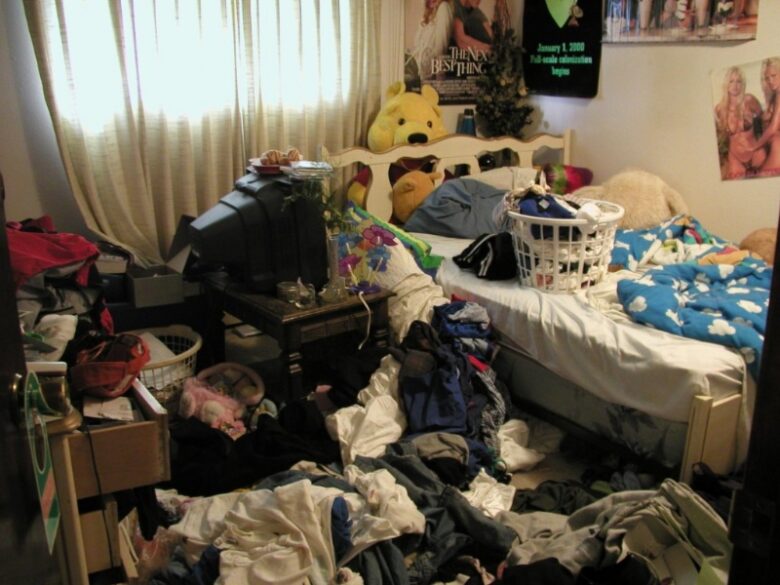
You see my home in South London was the top floor of a semi-detached house that had been made into flats. Due to this it, had an unusual design feature of a huge bedroom that was bigger than the living room. This meant that I used it to store all sorts of things in there - the ironing board, the hoover, piles of books etc, basically it had a lot of stuff in there. A lot. Somewhere amongst it all was my bed, with a lot of stuff stored under it. At that time I was not ready for changing my sleeping habits and I did not take any of this 'strange' advice easily and put up barriers as to why I couldn't change things.

When I came to France, I ended up in this amazing flat with 4 metre high ceilings - which gives it a great feeling of space. It has a bedroom, bathroom, mezzanine and a huge open plan living/kitchen area. The bedroom is tiny and could just about fit a double bed in and not much else. I realised that for the space to work for me I'd need to use the bedroom as my massage room (it's the perfect size for that) and sleep in the mezzanine above the bathroom. With the help of friends I managed to get my bed up there (you have to go up a ladder) and fortunately - not much else will go up there. The mezzanine is quite low and I can't stand up properly in it but I can sit up in bed, so I just spend my time up there sleeping. 

I now understand why all these magazine articles tell you to use your bedroom for sleeping. It is now an area that I associate with sleep, it is calm up there and not much to distract me. As I need help if I want to take anything up there that needs to be held with more than one hand, there is very little there. Now when I go up there, it is because I am tired and am going to bed. This strong association has helped my brain make a link between bed and feeling sleepy and, in turn, has helped me improve my quality of sleep.

Now I can really see why clutter is a problm for sleep. I worked with one client who showed me a picture of her bedroom and she had so much clutter in there it was hard to get to her bed. How can that be a productive environment for sleep, when your stuff is actually crowding in on your bed? Another woman mentioned that she slept on the sofa as her room had got to such a state that there was too much clutter actually on the bed! 


In coaching circles there is a lot of emphasis on clearing clutter. It helps you let go of the past and gives you physical space to allow more into your life, whether that be a new job or relationship. If your finances are in a mess, and you have no idea of your income and expenditure then the first thing a financial advisor will tell you to do is to sort out your paperwork and set up a budget. It's the same for sleep - if you want to attract more sleep into your life, then a peaceful tidy bedroom is going to be preferable in helping you relax and unwind after a busy day rather than a messy dumping ground! I would really encourage you to make your bedroom a place for sleep.

Take out the computer and the television
Go through your wardrobes and donate old clothes to charity (let someone else benefit from it!) 
Go through books and get rid of the ones you will not read again
Be brave and find out what is under the bed
Are there other places you can keep the ironing board and vacuum cleaner? (Can you clear a space elsewhere?)

Hopefully there won't be too much to do, but if it does seem like a daunting challenge start with one drawer or cupboard and see how much better you feel after completing that. I promise you, you will.
So arm yourself with a binbag for things to throw out, a box for charity donations and a box for recycling, put on some energetic music that makes you want to dance and have fun! 

If you would like moral support, motivation or just a plain old kick up the backside to get you started then why not join our Clearing the Clutter for Sleep live event (for free) on Saturday 28th September? Click here for more details. 

Sweet dreams.